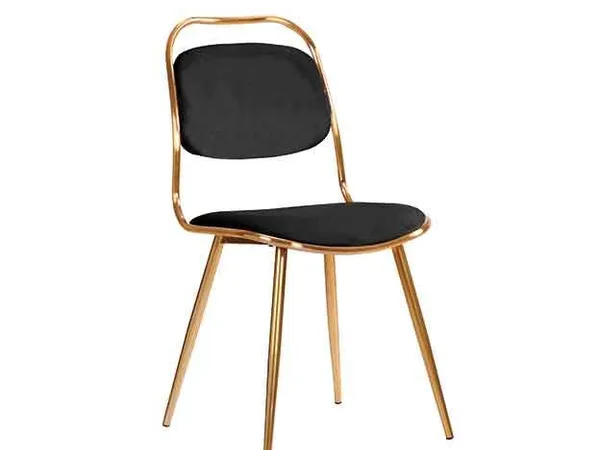
When a buyer sends me a competitor photo and asks us to "match this," the photo is the least useful part. Two metal folding chairs can look identical and weigh almost the same, yet one survives a banquet hall for eight years and the other starts wobbling in eighteen months. The difference is in two numbers that never make it into the product listing: the wall thickness of the steel tube, and the microns of powder coat on top of it.
Gauge: a smaller number is more steel
Furniture steel tube is specified by gauge, and the count runs backwards — a lower gauge number means a thicker tube wall and a stronger frame. Commercial seating typically sits in the 16 to 18-gauge band. Eighteen-gauge is roughly 1.2 mm of wall; sixteen-gauge is closer to 1.5 mm. That third of a millimetre does not sound like much until you remember it is wrapped around the whole tube and carries every load path through the chair.
On our folding chairs we default to 18-gauge for light commercial and 16-gauge where the chair will be stacked, dropped onto a dolly and sat in by adults all day. We also watch the tube diameter: a 22 mm tube in 16-gauge behaves very differently from a 19 mm tube in 18-gauge, even though a spec sheet that only lists "steel frame" tells you neither. If a quote will not name both the diameter and the gauge, that is the first thing to push on.
Powder coat: it is corrosion protection, not just colour
The coating is where price-driven suppliers cut quietly, because you cannot see microns. Industry guidance puts a general-purpose powder-coat film at roughly 60 to 120 microns — about 2.4 to 4.7 mil. Thinner than 60 and you get bare spots at the welds and edges where rust starts; much thicker than 120 and the film can chip on impact and waste material. We aim for the middle of that band, heavier on the foot ends and weld zones that take the abuse.
Here is the trade-off I put to buyers plainly. You can save a real amount per container by dropping to 18-gauge tube and a 50-micron coat. For a chair that sits in a home dining room, that is a sensible saving and I will quote it. For a chair going into a hotel that flips a ballroom twice a day, that saving comes back as bent legs and rust bleed at the welds inside two years — and the replacement freight alone erases it. We would rather lose the order than ship a frame we know will embarrass your brand.
The pre-treatment under the paint is half the corrosion story
Microns alone do not save a frame; what the steel got before the powder went on matters just as much. A bare tube that is only wiped down will rust under the coating within a year in a humid venue, no matter how thick the film. The frames we send into coastal and high-humidity markets go through a phosphate or equivalent pre-treatment first, so the powder has a clean, keyed surface to bond to. You cannot see this step on a finished chair, which is exactly why a price-cutter skips it. If a sample shows rust creeping out from a weld or an edge after a few months, the problem is almost never the powder thickness — it is the prep that was cut underneath.
The other quiet failure point is the inside of the tube. A folding chair leg is an open or capped tube, and if the inner wall is bare and the cap is loose, moisture gets in and rusts the frame from the inside out where no inspector looks. We cap the tube ends properly and, for harder markets, specify the inner surface treatment in the quote rather than leaving it to chance.
How to check it on your own order
Three asks before you confirm. First, get the tube diameter and gauge in writing on the proforma, not just "powder-coated steel frame." Second, ask for the coating thickness target in microns — a serious factory will give you a number and can measure it with a film gauge on the line. Third, for any humid or coastal destination, ask what pre-treatment the steel gets before coating, because that is where the real corrosion protection lives. We build our frames to those numbers and the seat strength is built and tested to BIFMA / EN methods; full lab testing can be arranged per order if your buyer needs a report.
If you want, send me the use case — home, light contract, or heavy banquet — the destination climate, and the quantity, and I will spec the gauge, coating and pre-treatment to match instead of over-building a chair you do not need or under-building one you do. Start through our contact form, see the range on the products page, read how custom runs work on our OEM / ODM page, or email [email protected].